
29 June 2020
The Guggenheim Museum Bilbao helps purify the city’s air through its outdoor advertising campaigns
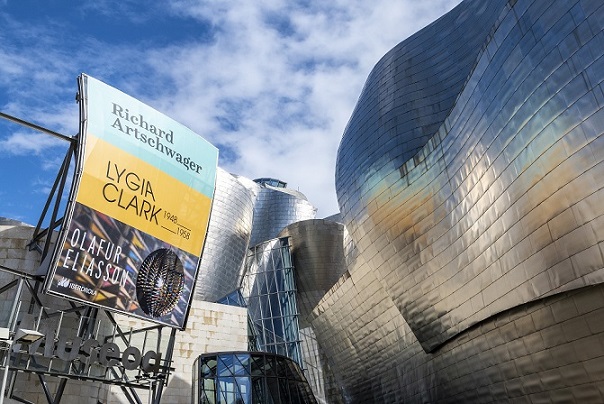
In an effort to contribute to improve the environment, the Guggenheim Museum Bilbao has decided to use a special coating in its outdoor advertising campaign materials that turns them into active air purifiers. This treatment is based on the natural process of photocathalysis, which causes a purifying effect similar to that of trees.
Thus, the large banner announcing the exhibitions on the Museum facade, the banners advertising the exhibition of artist Olafur Eliasson installed today in the lampposts along some of the main Bilbao streets, or the tram which will be entirely covered with advertising vinyl, will all be treated with Pureti® Print. Developed in collaboration with NASA and certified by different international laboratories, this technology is used by Estudios Durero during the production of the Museum’s graphic communication materials.
The present impact of these outdoor advertising campaigns could be equivalent to the air purifying effect of over 700 trees.
As Juan Ignacio Vidarte, Director General of the Museum, puts it: “a technology that allows us to help purify the air in our city was a great opportunity to go a step further in the Museum’s commitment to contribute, in all aspects possible, to stop climate change. Just as we are cutting down power consumption thanks to the change of the lighting systems in the Museum galleries, the possibility of purifying the air while acquainting our audiences with our art program was a great chance.”
A tested technology
The scientific basis of Pureti® Print is photocathalysis, a chemical reaction triggered by sunlight that turns oxygen and water vapor in the air into cleaning agents of pollutants such as NOx, SOx, or VOCs, as well as bacteria, mold, and bad odors. The benefits of this technology have been recognized by Tecnalia, a benchmark center in photocathalysis in Spain.
Pureti® Print is part of the European Project iSCAPE conceived to respond to the most important challenges that Europe will need to face in the future, with measures such as the development of actions to improve air quality and reduce pollution. Said project is part HORIZON 2020, the most important European Union Framework Program for Research and Innovation.
Just send an email to media@guggenheim-bilbao.eus, indicating your request.
Make sure you include the following information: type of video; date, time, and length; what to film (the building, the exhibitions, etc.); interview requests; special information requests.
If your request is approved, you must send a list of all team members before the day of the shooting.
The use of Museum images in videos and other audio-visual productions may be subject to a fee. Our Images Committee reviews every request individually. Since this may take three working days to two full weeks, we suggest you plan your video shooting ahead of time.
Just follow this link and download the images you need. For urgent requests, please contact us by email or phone.
All images must be properly attributed, without being altered, cropped, or overwritten. Reproductions other than the aforementioned require approval in writing from the Museum.
You will find all the relevant information about the exhibitions in the Press Room of our website. Once there, go to PRESS RELEASES > EXHIBITIONS.
Just show your press card at the admission desk for free admission. Please bear in mind that journalists are granted free admission to the Museum in exchange for promotion of the Museum’s exhibitions, activities, and events.
Just send an email to media@guggenheim-bilbao.eus, including all the relevant information about your work as a journalist and the media you work for.