

Art and emotions
Welcome to the Guggenheim Museum Bilbao!
Visit the Museum independently and discover the emotions that this selection of works from the Collection awakens in you. You will find that contemplating works of art and exploring the building designed by Frank Gehry will stir up all kinds of emotions and bring you a tremendous sense of well-being. We hope your experience proves to be rewarding.
MAPA
Transformation and multiplication
Water feature by the river
Head into the Museum, cross over the Atrium and then out onto the terrace. From there you will be able to see this dazzling sculpture.
When creating these kinds of site-specific installations, Anish Kapoor takes inspiration from architecture to create experiences that are at once intimate and collective. According to the artist, the sculpture is always in a state of ‘transformation’, going through various stages of self-generation, dissolution, fragmentation and multiplication.
For Kapoor, the body and the gaze of the onlooker are very important elements in this work: each person brings their subjective reality when contemplating and considering it.
What do you see in those reflective spheres and how do they make you feel?
Anish Kapoor
Tall Tree and the Eye, 2009
Stainless steel and carbon steel
1297 x 442 x 440 cm
Guggenheim Museum Bilbao

Weight, balance, movement...
Gallery 104, first floor
Richard Serra is one of the most important sculptors of the 20th century.
Weight, balance, materials (usually steel), movement and monumentality are some of the characteristics of his work. For Serra, public participation is essential for the completion of the work, as well as the relationship between sculpture and space.
In the installation The Matter of Time, composed of eight sculptures and the entire space that houses them, the artist employs geometric forms, some of which have never been used in sculpture before: from a double ellipsis to sections of toruses and spheres. This produces different effects on us, both in terms of perception and when it comes to moving around the installation. So how do they make you feel?
In this installation, there is also a progression of time: both the chronological time it takes us to go through and observe it from start to finish, and the time of the experience in which the fragments of our visual and physical memory remain, combine and are re-experienced.
Walk around the sculptures. Explore their interior and experience physical, temporal and emotional sensations. Take it at your own pace!
Richard Serra
The Matter of Time, 1994–2005
Weathering steel
Variable dimensions
Guggenheim Museum Bilbao

Your message of peace
Second floor terrace
Yoko Ono is a leading light in contemporary conceptual art, performance and participatory art, as well as an activist for peace, human rights and feminism.
She played a key role in the development of the Japanese avant-garde and was a member of the multidisciplinary and experimental art movement Fluxus in the US and in Europe.
Wish Tree for Bilbao is a participatory work of art in which the artist invites members of the public to write and hang wishes for ‘peace’ on certain dates. These messages are sent to Ono to become part of an international project promoting world peace. At other times, you just have to whisper them to the tree!
Come and take part. Always be gentle and mindful in your actions, understanding what they imply.
Yoko Ono
Wish Tree for Bilbao, 1996/2014
Handwritten framed text, olive tree, soil, wooden pot, lectern, labels, and pens
Variable dimensions
Guggenheim Museum Bilbao

Listening to the sea
Gallery 304, third floor
El Anatsui is a Ghanaian artist based in Nigeria and a leading figure in contemporary sculpture.
He is known mainly for his unique metal sculptures. He started out using aluminum bottle caps from alcoholic beverages to create his pieces. The artist found he was able to manipulate this material in numerous ways, offering varied interpretations of the history of Africa and colonialism.
His technical process is astounding. How do you think he does it?
Rising Sea warns us that nature and civilizations can undergo sudden transformations. Its scale is a metaphor for the enormity of climate change. Its organic, almost monochromatic forms contrast with the shiny titanium surface of the gallery’s exterior.
Think of all the stories the hundreds of elements that make up this sculpture might tell us. And what about that rising, silvery sea?
El Anatsui
Rising Sea, 2019
Aluminum and copper wire
800 x 1400 cm
Guggenheim Museum Bilbao

Multicolored art
Gallery 303, third floor
Andy Warhol, one of the forerunners of the Pop Art movement, used different types of images in his works, from famous faces to labels from food items and consumer products from ‘popular’ and mass culture. He obtained them from newspapers, ads, etc.
This piece explores the iconic image of Marilyn Monroe, depicting the actress’s face 150 times! Warhol achieves this through silkscreen printing, a technique involving mechanical reproduction, and in this case reversing the colors to create evocative, almost ghostly negative images.
Marilyn Monroe was an actress, singer and model, once a huge icon of pop culture. She was a rebellious, free spirit. Did you know she was the first woman to set up and run her own film production company?
Andy Warhol
One Hundred and Fifty Multicolored Marilyns, 1979
Acrylic and silkscreen on canvas
201 x 1,055 x 6 cm
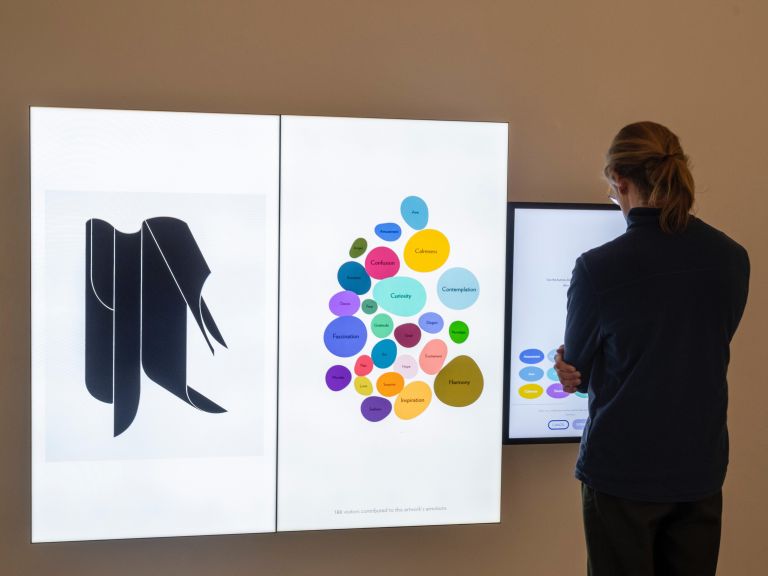
ARTETIK: From the Art
Corridor next to gallery 303
What do you feel when you look at a work of art? Do other people experience the same thing when looking at the same piece? Don’t miss the digital initiative ARTETIK: From the Art!
This installation allows you to explore your emotions in relation to the works of art that are part of the Guggenheim Bilbao Collection. It is a digital experience that is gradually completed over time, generating a collective graph of emotions as different people interact with this tool.
Experience art with the Museum Collection and share your emotions!
This project is a collaboration between the Guggenheim Museum Bilbao and Google Arts & Culture.
This tour has now come to an end. But these are just a few examples of how art can make you feel. Let yourself be carried away. Continue visiting the museum on your own and experiencing new emotions. You’ll be amazed!
We hope you have enjoyed and felt good about this experience. See you soon!